When CEL-UK started to sell the Robox® 3D printers there was a lot of excitement in the press and there was the expectation that everyone would have a printer in their homes, in much the same way they might have a printer for their computer. Although the Robox® printers sold well, particularly into the education sector, the market never quite developed as expected and it soon became clear that 3D-printing was becoming an engineering tool, and the FFF-type printers that CEL-UK were expert in, where best suited to prototyping, making jigs and fixtures and short manufacturing runs where tooling costs made other manufacturing techniques uneconomic.
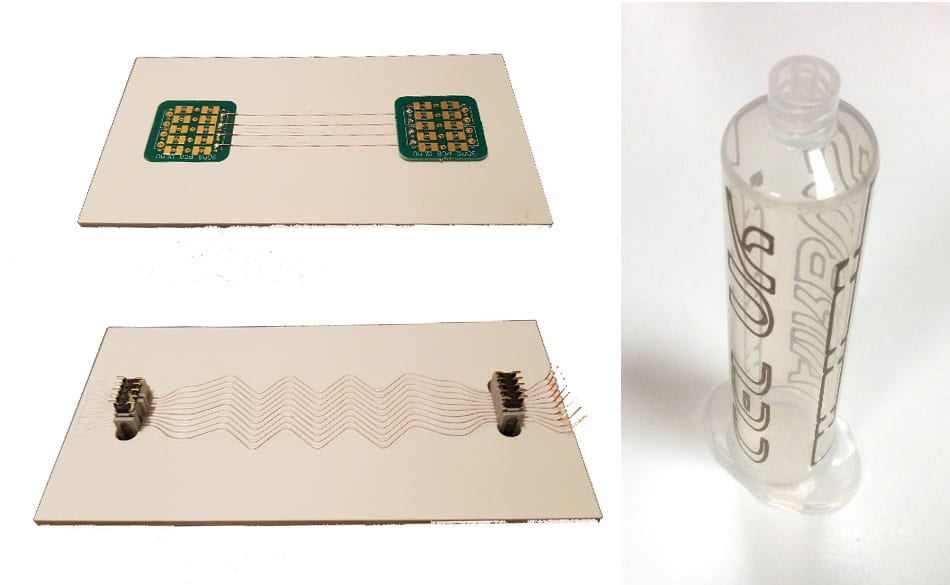
When CEL-UK began to look at incorporating conducting elements into the print it quickly became clear that this was an area in which additive manufacturing could compete directly with existing manufacturing methods. Wiring harnesses are still largely made by hand, which is slow, costly and prone to error. Although there has been some progress in recent years to try and automate parts of this process, the final layout is still done with a pin-board.
Once CEL-UK decided that it was going to use printed electronics as well as embedded copper wire to add conducting elements then the design of the new system started take shape.
“…incorporating conducting elements into the print … was an area in which additive manufacturing could compete directly with existing manufacturing methods.”
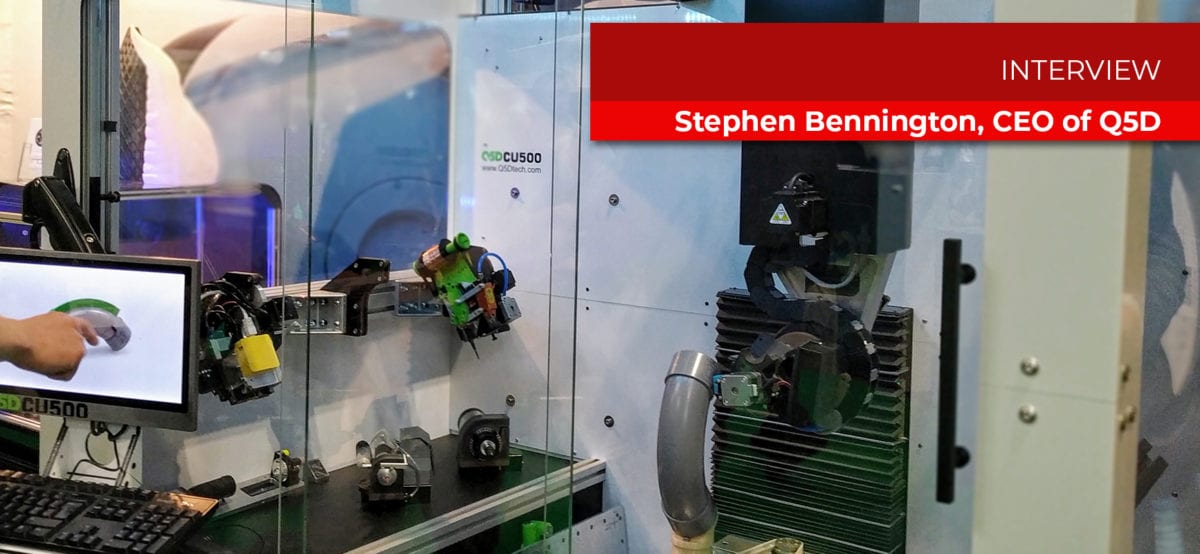
Firstly: it became necessary to use a 5-axis platform as this was the obvious way to create the smooth compound surfaces onto which you could print the electronics directly.
Secondly: the flexibility that 5-axis platform brings makes it possible to print directly onto existing components. Using the Q5D tools to functionalize an existing part that is made by injection molding or metal pressing is faster and more cost effective for a mass-produced part.
One problem remained; all the existing printed electronics technologies use silver paste. Whilst this works well, it requires a curing stage where the part needs to be baked in an oven. This makes it necessary to dismount the part from the Q5D tool part way through the manufacture.
“…the flexibility that 5-axis platform brings makes it possible to print directly onto existing components. “
Chris Elsworthy the CEO of CEL-UK found the ideal solution to this problem at a meeting of the Bessemer Society a group of people who run high-tech manufacturing businesses in the UK, he was introduced to Phil Rumsby the CEO of M-Solv. M-Solv had developed a technology that used lasers to cure and sinter copper paste, not only is copper paste much less expensive than silver, it removed the need to use an external oven. They determined to join forces and together set-up Q5D.